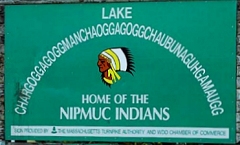
News from Lake Chargoggagoggmanchauggag
oggchaubunagungamaug

webster_lake.jpgListening to a radio program tonight while tying flies, I heard a voice (two actually) from out of the past. It was Ethel Merman and Ray Bolger singing a song about a lake in western Massachusetts that I hadn’t heard in over fifty years but which was one I enjoyed singing when I was a kid. A song with the simple but tongue-twisting title of “Chargoggagoggmanchauggagoggchaubunagungamaugg.” (In case you’re wondering, yes, I did have to look up the proper spelling). Just repeating this word over and over used to drive my parents crazy–which is probably one reason why I liked the song so much.

Another reason was that it reminded me of happy summer days fishing on this lake. This was, after all, where I had caught my first largemouth bass, first pickerel, and first horned pout (none on flies but that didn’t matter at the time). It was also where I learned to water-ski (well, sort of). It was a magical place with a magical name: Lake Chargoggagoggmanchauggagoggchaubunagungamaugg (also called Lake Webster by the phonetically challenged).

Thinking about this lake, I decided to do a little research. Here’s what I found; well, some of what I found. From Wikipedia:

Chargoggagoggmanchauggagoggchaubunagungamaugg (pronounced: don’t even try), a 46-letter alternative name for this body of water, is often cited as the longest place name in the United States and 6th longest in the world. Its 15 uses of “g” are the most instances of any letter in a word. The name also contains 9 instances of the letter “a” (not including the “a” in “lake”), more than any word in the English language.

This longest name means approximately “Englishmen at Manchaug territory at the meeting and fishing place at the boundary” and was applied in the 19th century when White people built factories in the area. “Manchaug” is derived from the “Monuhchogoks”, a group of Nipmuck Indians that lived by the lakeshore. Spelling of the long name varies, even on official signs near the lake.

I’ll bet you didn’t know this. I’ll bet also that you didn’t know that it’s still another week or so away from the arrival of striped bass in the Boston Harbor area. As I sit here counting the days until I can get back to the salt–weather permitting, of course–I’m wondering if the largemouth bass are now preparing their spawning beds on Lake Chargoggagoggmanchauggagoggchaubunagungamaugg. I’ll bet that they are.

Yes but I photograph well

old_fisherman.jpgOur friend and neighbor Dave Skok just returned from a trip to Costa Rica where, in additional to catching a few fishies, he also took some amazing photographs. A short selection of them is posted on Moldy Chum (which, coincidentally, is probably also a fair description of Dave after several weeks in the jungle). Take a look at the brilliant reds on the Costa Rican rainbows–their flanks look like sunrise in a Turner watercolor.

All tied up

tied_up.jpgIn the current Pointless Poll (see the Home Page) it’s a dead heat for favorite knot between the improved clinch and the loop knot. Which is surprising to me. I like loop knots, don’t get me wrong, I just never realized how many people use them on a regular basis. The clinch knot was the first fishing knot I ever learned. When the improved clinch came out I switched over to it because it was, well, improved. And that’s pretty much where I’ve been ever since.

There’s an odd tendency for certain knots to stick in your brain, while others don’t. I have this theory that once a knot takes possession of your mind it gets territorial and uses its knotty powers to prevent other knots from gaining a place. For example, the trilene is a great knot. But somehow, even though it’s not that complicated, I can’t seem to tie one unless I have a diagram in front of me. The improved clinch just refuses to let it reside in my grey matter. Conversely, I have no problem remembering how to tie blood knots, nail knots, snells, bowlines, and sheepshanks. It’s as if the improved clinch realizes that these knots are not direct competition.

Jack likes to laugh and say, “I know two knots, and one of them is a wind knot.” We’ve fished together for over ten years and he still won’t tell me what that second knot is. It can’t be all that great because, as fine a fisherman as he is, he does snap off quite a few fish. Or maybe it’s the knot itself asserting its will, coming undone on purpose to get even with him for not giving knots their due respect.

A few years ago Jack and I were into some fast and heavy striper action when a nice bass snapped off his fly. So he tied on another one and the next fish snapped off his entire leader. Unperturbed, he tied a fly directly to the fly line and in short time hooked a really big fish which ran him into his backing–before breaking that off and swimming away with the fly line. After that he was reduced to flailing away with a fly tied to nothing but backing. Even then he caught a few more fish until finally the current died and the bass moved off.

Yet again: More new stuff on the web site

maid_2.jpgAs a follow-up to Jack’s post about credit cards, here are a few other new additions to the web site. Hopefully this will be the last post of this type for awhile–we need to stop coding and get to fishing! But if nothing else it gives us a chance to post another picture of a sexy girl in a French maid outfit. 🙂

RSS Feed: We now have an RSS feed for the site. Actually, we have two: one for articles and one for the blog. What’s an RSS feed? We’re not 100% sure, but one of Jack’s readers (MarkS) suggested it and since it was raining that day and we were tipsy on drambuie we said, oh well, what the hell. Actually, an RSS feed is a kind of “live” bookmark you can add to the bookmarks in your web browser. Whenever new content is added to the site, the bookmark displays it automatically, saving you the trouble of visiting the site to see if there’s anything new.

New Mailer: We upgraded the software that runs the mailing list for Jack’s newsletter. Jack used to just enter email addresses manually in the address book on his computer which made subscribing and/or unsubscribing from the list a bit of a process. Now you can do it all yourself. There are also security safeguards in place so that you, and only you, can add or remove yourself from the list.

New Pointless Poll: The old software we used to publish the Pointless Poll was limited to five poll choices. We’ve now got a new one that allows up to ten. It also allows you to leave comments (a feature we haven’t turned on yet but will in the near future).

Language Translator: We’ve added a Google gadget that translates the entire site into any one of a dozen languages at a single click. It’s located in the sidebar on each page. The translations are not 100% perfect, but hopefully are good enough so that non-English speakers can understand the gist of the pages they’re reading. Several caveats about the translator: 1) whenever you use the pull-down menu (located at the top of each page) it reloads the whole site as English again. Of course, you could run the translator again, but you might be better served to navigate using the text links that appear at the bottom of each page; 2) for those making a purchase, the shopping cart and checkout pages are not translatable. Sorry, but there’s nothing we can do about that.

Old Pages and New Pages: We’ve upgraded the content on a lot of existing pages and added three new ones: a page about JackGartside.com, a page for the downloadable order form (for those who prefer to order by check or through the mail), and a page describing Jack’s security and privacy policies. You’ll find all three on the Contact & Ordering menu.

I am now accepting credit cards

jeanette21.jpgBy popular demand–and due to the diligent and exceptional efforts of my webmaster Mike Quigley–I’m now accepting credit cards. This is a big step forward for me, and an exciting one, since it makes ordering a lot easier for my customers (and hopefully gives my little business a boost as well).
So, to all my readers who prefer to pay with a credit card, I can now say, Welcome Aboard. And of course those who prefer to pay be check can continue to do so.

FAQs–Frequently Asked Questions

wizard.jpg Just taking a break from writing up my newsletter for April. In it I try to answer some of the more frequently asked questions that have been put to me over the years. Since many of my blog-readers may not receive the monthly fly fishing newsletter, I thought I’d post the questions and answers here as well. If you’d like to receive a newsletter, by the way, please sign up for it on the home page.
Frequently Asked Questions

1. (and this is the most-frequently asked question)

Do you personally tie all the flies that you have for sale?

Yes, I do personally tie each and every one. Which is why I sometimes get behind a bit in filling orders, especially during the busy winter months (January and February especially), when I’m traveling a lot. If you order selections of flies, there’s generally no delay in getting these out; I usually have most of the selections on hand. It’s the orders for individual flies that take a bit longer since I often have very few individual flies in stock and must tie each one to order and I tie each individual order in the order in which they arrive. Since I’m a fairly slow and methodical tyer I may tie up only about three dozen flies on an average day (that is if my eyes and back don’t act up on me, in which case I’ll tie fewer). Eventually, though, all the flies get tied and everybody’s patience is rewarded. The best time to order individual flies or those flies not offered in selections is generally April through July and again in September and October, when I’m traveling less and I have more time to tie.

2. Do you have a shop?

No. Because of the web site, many people make the assumption that I have a shop or operate a large fly tying consortium but this is far from the truth. A laugh, really, since there’s just me, myself, and I to do all the tying, packaging, writing, and all the other chores that need to be done.

3. Do you make a good living doing what you do?

An honest answer to this is: Hell, no!–BUT I make a great life.

4. How long have you been tying flies?

I was taught to tie my first fly by the late, great Ted Williams of the Boston Red Sox. This was in 1956 or 1957 (can’t remember now exactly which year). I was just a young lad at the time and Ted was my idol. At the time I had never seen a fly tied before but I figured that if Ted was interested in fly tying, this was something I’d like to know more about. I’ve been tying regularly ever since.

5. Where do your fly-tying ideas come from? Or, another variation of the same question, What inspires you to come up a certain pattern?

These are difficult questions to answer meaningfully. I’m an habitual experimental tyer and my tying area is often a chaos of materials. Out of this chaos, I am sometimes moved to create order. Ideas come to me most often when I’m bored with the repetition of tying a single pattern over and over again, flies that require no thought to their construction or design but only rote mechanical skill. It’s then that my mind is free to range over the possibilities that exist within all the different materials spread out before me. Once I focus on a particular material (say a pheasant feather), I try then to imagine all the particular uses to which that feather can be put. And so on.

It should be said at this point that I have hundreds of ideas in the course of a year–but only one or two of them ever turn out to be GOOD ideas; the others not so good, some downright foolish. But it’s the pursuit of the good idea–that perfect expression of a perfect fly, for instance–that keeps me involved, enthused, and searching–and occasionally satisfied. After many years of tying, the successes remain and the failures are forgotten.

Bonefish & Tarpon Unlimited

logo_btu1.gifIf you’re a tarpon or bonefisherman, you’ll want to learn more about Bonefish & Tarpon Unlimited, a group doing important work with these species and whose research and activities I wholeheartedly support–and urge you to support as well.

To quote from their home page, “Bonefish & Tarpon Unlimited was developed for a simple reason – to support research, education, and conservation of bonefish and tarpon. At BTU’s inception in 1998, little data existed on bonefish and tarpon, two of the world’s most popular saltwater gamefish.

BTU is made up of recreational anglers, guides, and marine industry leaders dedicated to increasing our knowledge of bonefish and tarpon biology so we may better manage these species and ensure the fisheries for future generations.

To visit their site, click on this link: http://www.tarbone.org/

I was introduced to BTU by Aaron Adams, author of Fisherman’s Coast and most recently Fly Fisherman’s Guide to Saltwater Prey
(both of which I recommend highly), who was representing BTU at the Flyfishing Show in Somerset, NJ this past January. After listening to his persuasive discussion of BTU and their work I gave him fifty bucks, signed up as a member, and got a really neat hat with a BTU logo on it as part of the deal. Aaron’s been doing a lot of important work with BTU and if you can help him out in any way, that would be great. He has a really interesting website also that I recommend looking into:

http://www.fishermanscoast.com

It has a lot of useful and interesting information on it about: about conservation, fish habits, flies, fishing tips, as well as writings about his own fishing excursions and a frequently updated blogwhere he shares whatever thoughts are on his mind. His website is called Fisherman’s Coast, subtitled Learn to Think Like a Fish.This is something we should all learn at some time in our fishing and Aaron’s writings go a long way towards helping us.